Choosing between WooCommerce and Shopify in 2025 can make or break your online business. With ecommerce sales growing fast and mobile shopping reaching 73% of all traffic, picking the right platform is crucial for success.
Market Share: The Big Picture

Global Ecommerce Platform Market Share 2025
WooCommerce leads the global market with 38.76% market share, powering 4.53 million stores worldwide. However, it saw a -3.2% decline in 2025, its first major drop.
Shopify holds 10.32% market share with 4.8 million active stores and shows strong 8.2% growth. During Black Friday 2024, Shopify processed $11.5 billion in sales – a 24% increase from the previous year.
Quick Stats:
- WooCommerce: 38.76% market share, declining growth
- Shopify: 10.32% market share, strong growth
- Together they control nearly 50% of all online stores
Cost Breakdown: What You’ll Really Pay

Understanding real costs helps you budget properly for your online store.
Small Business (Under 1,000 orders/month):
- WooCommerce: $75-$920 per year (hosting, plugins, themes)
- Shopify: $348-$1,800 per year (monthly plans plus apps)
Medium Business (1,000-10,000 orders/month):
- WooCommerce: $1,420-$6,550 per year (better hosting, premium features)
- Shopify: $948-$5,400 per year (higher plans, more apps)
Large Business (10,000+ orders/month):
- WooCommerce: $6,450-$30,700 per year (dedicated servers, custom work)
- Shopify: $4,788-$27,600 per year (advanced plans, enterprise features)
Hidden WooCommerce Costs:
- Web hosting: $20-$500/month
- Security plugins: $100-$400/year
- Developer help: $1,000-$5,000/year
Hidden Shopify Costs:
- Transaction fees: 2.4-2.9% per sale
- App subscriptions: $500-$3,000/year
- Theme purchases: $100-$350 one-time
Speed and Performance: Who’s Faster?
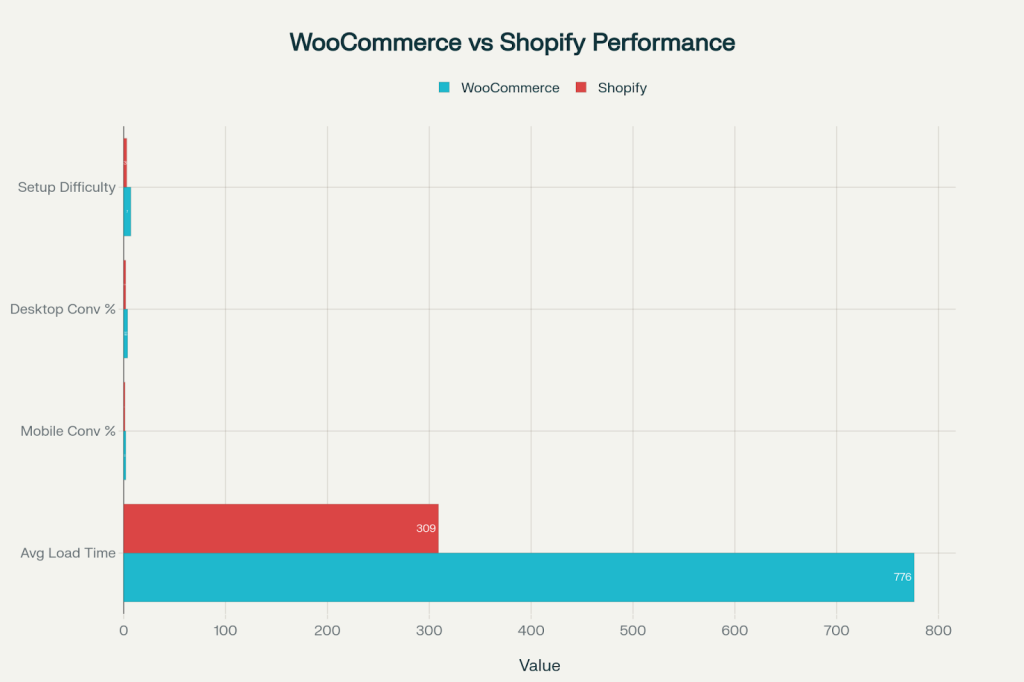
WooCommerce vs Shopify: Key Performance Metrics Comparison
Website speed directly affects sales and search rankings.
Loading Times:
- Shopify: 309 milliseconds average
- WooCommerce: 776 milliseconds average
Despite being slower on average, WooCommerce stores often convert better:
Conversion Rates:
- WooCommerce Mobile: 2.03%
- Shopify Mobile: 1.2%
- WooCommerce Desktop: 3.83%
- Shopify Desktop: 1.9%
This suggests that customization and user experience matter more than raw speed for converting visitors into customers.

Make the Smart Ecommerce Choice

Pooja Upadhyay
Director Of People Operations &
Client Relations
Mobile Commerce: The Future is Mobile

Mobile Commerce Growth Trends 2021-2025
Mobile shopping dominates ecommerce in 2025, making mobile optimization essential.
Mobile Traffic Growth:
- 2021: 58% of ecommerce traffic
- 2025: 73% of ecommerce traffic
- 2030 Projection: 88% of ecommerce traffic
Mobile Features:
- Shopify: Built-in mobile themes, automatic optimization
- WooCommerce: Requires manual setup but offers better customization
Both platforms work well on mobile, but Shopify makes it easier while WooCommerce gives you more control.
Ease of Use: Simple vs Flexible
Shopify Advantages:
- Set up your store in minutes, not days
- No technical knowledge required
- 24/7 customer support via phone, email, and chat
- Automatic updates and security
WooCommerce Advantages:
- Complete control over your store design
- 59,000+ WordPress plugins available
- No monthly fees (just hosting costs)
- Better SEO capabilities with WordPress
Winner for Beginners: Shopify wins for ease of use, while WooCommerce wins for flexibility.
Features Comparison: Built-in vs Add-ons

Feature Comparison: WooCommerce vs Shopify by Business Size
Different business sizes need different features.
Small Business Needs:
- Shopify: 9/10 for easy setup, 6/10 for customization
- WooCommerce: 3/10 for easy setup, 9/10 for customization
Enterprise Business Needs:
- Shopify: 10/10 for automatic scaling, 10/10 for support
- WooCommerce: 9/10 for unlimited growth, 10/10 for integrations
Industry Preferences: Who Uses What
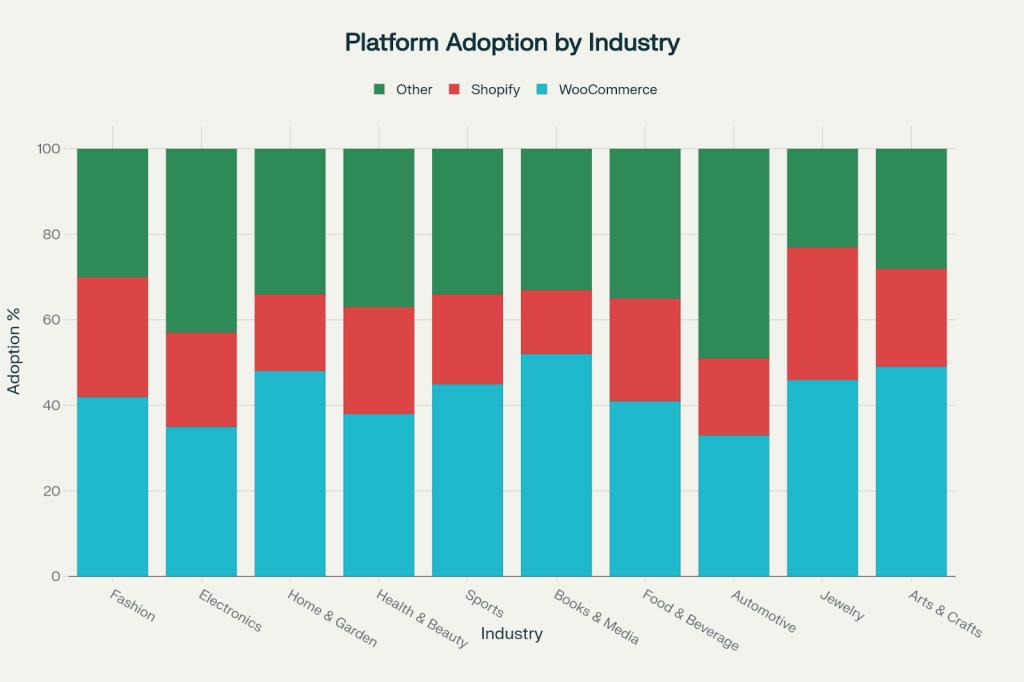
Platform Adoption by Industry: WooCommerce vs Shopify vs Others
Different industries prefer different platforms based on their specific needs.
WooCommerce Popular Industries:
- Books & Media: 52% adoption
- Arts & Crafts: 49% adoption
- Home & Garden: 48% adoption
- Sports & Outdoors: 45% adoption
Shopify Strong Industries:
- Jewelry & Accessories: 31% adoption
- Fashion & Apparel: 28% adoption
- Health & Beauty: 25% adoption
- Food & Beverage: 24% adoption
Content-heavy businesses prefer WooCommerce for its flexibility, while fashion and beauty brands like Shopify’s streamlined approach.
SEO and Marketing: Getting Found Online
WooCommerce SEO Strengths:
- Full WordPress SEO power with plugins like Yoast
- Complete control over URLs and meta tags
- Built-in blogging for content marketing
- Better long-term SEO potential
Shopify SEO Features:
- Built-in SEO tools that work automatically
- Good basic optimization features
- Limited customization compared to WordPress
- Easier for beginners to manage
For serious SEO and content marketing, WooCommerce has the edge due to its WordPress foundation.
Security: Managed vs Self-Managed
Shopify Security (All Included):
- Automatic SSL certificates
- Built-in payment security (PCI compliance)
- 24/7 monitoring and updates
- No security work required from you
WooCommerce Security (Your Responsibility):
- Need to buy and install SSL certificates
- Must install security plugins
- Regular updates required
- Security depends on your hosting provider
Shopify handles all security automatically, while WooCommerce requires you to manage it yourself.
Apps and Extensions: Adding Features
Shopify App Store:
- 13,000+ apps available
- Most apps cost monthly fees
- Easy one-click installation
- Quality controlled by Shopify
WooCommerce Extensions:
- 900+ WooCommerce-specific extensions
- 59,000+ WordPress plugins
- Mix of free and paid options
- More flexibility but requires research
Both platforms offer plenty of add-ons, but Shopify’s are easier to use while WooCommerce’s are more flexible.
Global Expansion: Selling Worldwide
WooCommerce Global Features:
- No limits on countries or currencies
- Any payment processor in any country
- Complete control over international features
- Unlimited market expansion
Shopify Global Limitations:
- Maximum 50 international markets
- Shopify Payments not available everywhere
- Multi-currency tied to Shopify Payments
- Extra fees for additional markets
For serious international expansion, WooCommerce offers unlimited potential while Shopify provides easier management with restrictions.
Future Technology Trends

Future E-commerce Technology Trends 2025-2030
Looking ahead to 2030, several technologies will reshape online shopping:
AI Adoption:
- 2025: 35% of stores using AI
- 2030: 95% projected adoption
Voice Shopping:
- 2025: 2% of transactions
- 2030: 25% projected share
AR/VR Shopping:
- 2025: 8% of retailers offer AR/VR
- 2030: 62% projected adoption
Both platforms are investing in these technologies, but WooCommerce’s open-source nature may provide more flexibility for emerging tech.


WooCommerce or Shopify—whichever you pick, we’ll help you unlock its full potential.
 Level Up With AddWeb
Success Stories: Real Business Results
WooCommerce Success:
- Universal Yums delivered 10+ million subscription boxes
- Nutribullet improved conversion rates by 35%
- PickandMix.com achieved 24x revenue growth
Shopify Success:
- Pilgrim handled 1,556 transactions per minute during flash sales
- Knya increased online revenue by 105% after migration
- Bombas saved $108,000 in platform costs in year one
Both platforms can drive major business growth when matched to the right use case.
The Decision: WooCommerce or Shopify?
Choose WooCommerce if you:
- Want complete control over your store
- Have technical skills or budget for developers
- Need advanced SEO and content marketing
- Plan to expand globally without limits
- Prefer lower long-term costs
- Need complex B2B features
Choose Shopify if you:
- Want to launch quickly without technical hassles
- Prefer predictable monthly costs
- Need 24/7 professional support
- Want automatic security and updates
- Focus on selling rather than managing technology
- Are new to ecommerce
Final Verdict
Both WooCommerce and Shopify can power successful online stores in 2025. Your choice depends on your priorities:
- Shopify wins for beginners, quick setup, and managed simplicity
- WooCommerce wins for flexibility, SEO power, and long-term cost savings
Most successful businesses choose based on their technical comfort level and growth plans. Shopify gets you selling faster, while WooCommerce gives you more control as you grow.
The ecommerce market will keep evolving, but both platforms will adapt. Pick the one that matches your current needs and future vision – you can always migrate later as your business grows and changes.
Source URLs:
- https://www.shopify.com/enterprise/blog/global-ecommerce-statistics
- https://www.shopify.com/in/compare/shopify-vs-woocommerce
- https://kinsta.com/wordpress-market-share/
- https://woocommerce.com/posts/woocommerce-pricing/
- https://www.shopify.com/in/pricing
- https://woocommerce.com/posts/woocommerce-hosting/
- https://www.shopify.com/international/pricing
- https://www.reddit.com/r/SEO/comments/q4j3jb/shopify_vs_woocommerce/
About the Author: Mahima Dave is a Client Account Manager at AddWeb with 5+ years of experience in WordPress and client relationship management. She has been actively involved in the WordPress community through contributions and events, while also excelling at building strong client connections, ensuring seamless communication, and driving project success