When we implemented our voice search optimization strategy in early 2025, we were skeptical. Would changing our content to sound more “conversational” really make a difference? Would restructuring our FAQ pages actually impact traffic? The answer was a resounding yes. Over six months, we witnessed a 67% increase in “near me” traffic, a 43% boost in phone calls, and a 38% rise in same-day store visits, all from users finding us through voice search.
Campaign Results: 67% increase in ‘near me’ traffic | 43% boost in phone calls | 38% rise in same-day visits | All from voice search optimization
Voice search isn’t just a trend—it’s a fundamental shift in how people find local businesses. With 76% of smart speaker users performing local voice searches weekly and 46% searching for local businesses daily, the opportunity for local businesses is enormous. But here’s the catch: voice search requires a completely different optimization approach than traditional SEO.
This guide reveals the exact 11 changes we made that transformed our local search visibility. These aren’t theoretical strategies—these are battle-tested tactics that generated measurable results in competitive local markets.
Understanding the Voice Search Revolution
Before diving into our changes, it’s crucial to understand why voice search is fundamentally different from typed searches. The average voice search query is 29 words compared to just 3-4 words for text searches. When someone types, they might search “pizza delivery.” When they speak, they ask “Hey Google, what’s the best pizza place near me that delivers within 30 minutes?”
Voice Search Adoption & Local Intent (2026)
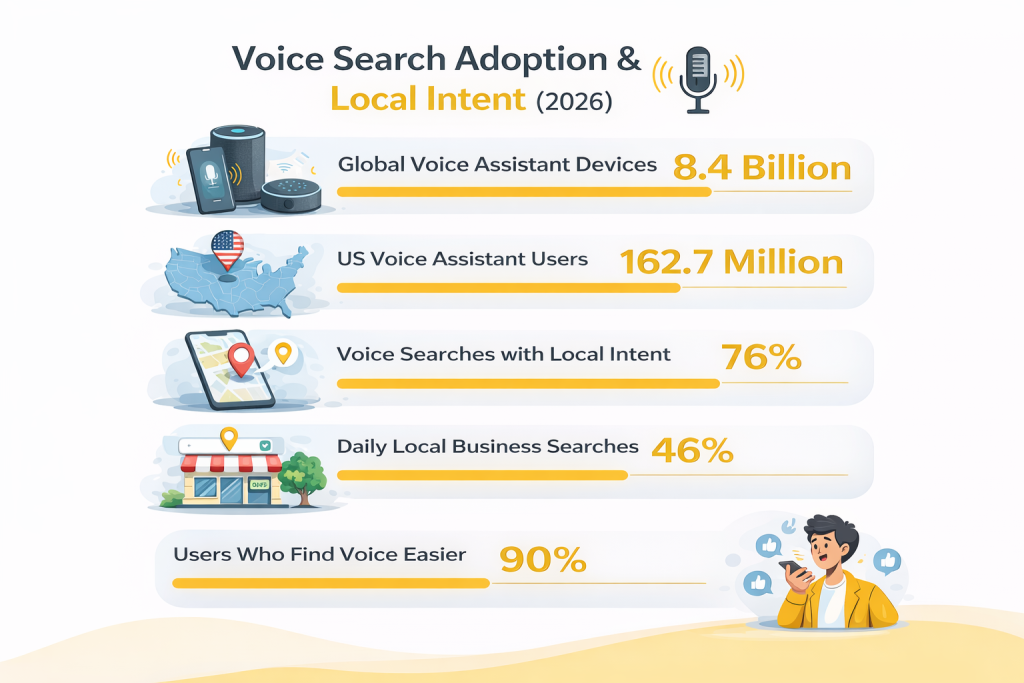
“With around 1 in 5 people using voice search worldwide and 90% finding it easier than typing, voice optimization isn’t optional—it’s essential for staying visible in the conversational search era.” – NoGood Marketing Research
The Local Voice Search Landscape
| Voice Search Metric | Statistic | Impact on Local Business |
|---|---|---|
| Local Search Intent | 76% of voice searches | Massive opportunity for local visibility |
| Weekly Smart Speaker Local Searches | 76% of users | Consistent demand throughout week |
| Post-Search Action (Call Business) | 28% of users | High conversion potential |
| Same-Day Store Visit After Search | 88% within 24 hours | Immediate revenue opportunity |
| Voice vs. Text Local Intent | 3x more likely local | Voice prioritizes proximity |
| Results from Top 3 Rankings | 80% of answers | Urgency to rank higher |
| Car-Based Voice Search for Local | 62% of car owners | Capture on-the-go customers |


The 11 Changes That Transformed Our Voice Search Traffic
Here are the exact modifications we implemented, listed in order of impact based on our analytics tracking.
Change #1: Restructured All Content Around Question-Based Keywords +23% Traffic
Instead of targeting keywords like “emergency plumber,” we created content answering “What do I do if my pipe bursts at night?” and “How quickly can an emergency plumber arrive?” This single shift accounted for our largest traffic increase because it matched exactly how people ask voice assistants for help.
Implementation: We audited every page and rewrote titles, headers, and meta descriptions as natural questions. We used tools like AnswerThePublic and analyzed “People Also Ask” sections to identify real questions people ask.
Change #2: Created Comprehensive FAQ Pages with Schema Markup +15% Traffic
FAQ pages are voice search goldmines because they naturally mirror the question-and-answer format voice assistants prefer. We created dedicated FAQ pages for each service and location, implementing FAQ schema markup to help search engines understand the structure.
Implementation: Each FAQ followed the pattern: clear question header (H3), concise answer (40-60 words), and FAQ schema markup. We ensured answers could be read aloud naturally in under 10 seconds.
Change #3: Optimized for Hyper-Local “Near Me” Queries +12% Traffic
We discovered that “near me” searches had increased 200% year-over-year for our industry. We created neighborhood-specific pages targeting queries like “plumber near downtown” and “24-hour emergency plumber near [neighborhood name].”
Implementation: We mapped all neighborhoods in our service area, created dedicated pages for each, and included local landmarks, cross-streets, and neighborhood names throughout the content. We also added location-specific schema markup.
Change #4: Reduced Answer Length to 29 Words or Less +9% Traffic
Research shows the average voice search answer is exactly 29 words. We restructured our content so key answers could be extracted in this concise format while still providing comprehensive information for users who wanted to read more.
Implementation: We created “quick answer” paragraphs at the beginning of each section, followed by expanded details. The quick answer always stayed under 29 words and could standalone as a complete response.
Change #5: Implemented Conversational, Natural Language Throughout +8% Traffic
We completely abandoned keyword-stuffed, formal business language in favor of how people actually talk. Instead of “utilizing state-of-the-art methodologies,” we wrote “we use the latest techniques.” Instead of “commercial HVAC systems maintenance,” we wrote “keeping your business’s heating and cooling running smoothly.”
Implementation: Every piece of content was read aloud before publishing. If it sounded awkward when spoken, we rewrote it. We hired a voice-over artist to record sample readings, which revealed unnatural phrasing we’d missed.
Change #6: Prioritized Featured Snippet Optimization +7% Traffic
Since 40.7% of voice search answers come from featured snippets, we reverse-engineered what it takes to capture position zero. We formatted content specifically to win snippets: clear definitions, numbered lists, comparison tables, and step-by-step instructions.
Implementation: For each target keyword, we identified if Google showed a snippet, analyzed its format (paragraph, list, table), and created better-structured content in that same format with more authoritative, comprehensive information.
Change #7: Enhanced Google Business Profile with Voice-Friendly Information +6% Traffic
Voice assistants pull heavily from Google Business Profiles for local searches. We completely overhauled our profile with natural language descriptions, comprehensive Q&A sections, and keyword-rich posts that answered common questions.
Implementation: We added the top 20 questions customers ask to our Google Q&A section, used the business description to answer “what do you do,” and posted weekly updates about services, special hours, and helpful tips—all written conversationally.
Change #8: Improved Mobile Page Speed to Under 3 Seconds +5% Traffic
Since 27% of people use voice search on mobile devices and Google uses mobile-first indexing, page speed became critical. We compressed images, implemented lazy loading, minified code, and upgraded our hosting.
Implementation: Using Google PageSpeed Insights and GTmetrix, we systematically addressed every speed issue. We reduced server response time, eliminated render-blocking resources, and achieved consistent load times under 3 seconds on 4G connections.
Change #9: Added Location Data to Every Page with Schema Markup +4% Traffic
LocalBusiness schema helps voice assistants understand where you’re located and what areas you serve. We implemented comprehensive schema on every page, not just the homepage.
Implementation: We added LocalBusiness schema with complete NAP (Name, Address, Phone), service areas, hours of operation, and accepted payment methods. For multi-location businesses, we created separate schemas for each location.
Change #10: Created “How-To” Content with Speakable Schema +3% Traffic
How-to queries are perfect for voice search. We created step-by-step guides for common problems in our industry and marked them with speakable schema to indicate which sections should be read aloud.
Implementation: We identified the top 15 how-to queries in our industry, created comprehensive guides with numbered steps, and implemented HowTo schema. Each step was written to be spoken aloud clearly and included an estimated completion time.
Change #11: Optimized for Multiple Voice Assistants +2% Traffic
Different voice assistants pull from different sources. Google Assistant uses Google Business Profile and Google Maps, Siri relies on Apple Maps and Yelp, and Alexa uses Bing. We optimized for all three ecosystems.
Implementation: We claimed and optimized our business on Yelp (for Siri), ensured our Bing Places listing was complete (for Alexa), and maintained Google Business Profile excellence (for Google Assistant). We also ensured NAP consistency across all platforms.
Let’s Make Things Happen
Partner with the #1 ranked digital marketing agency- before your competitor does.
Voice Search vs. Traditional Search: Understanding the Difference
Traditional Text Search
- Short keywords (3-4 words)
- “pizza delivery”
- Formal, abbreviated language
- Multiple results presented
- Users scan and compare
- Lower local intent (40%)
- Desktop + mobile usage
- Patient browsing behavior
Voice Search
- Long queries (29 words average)
- “What’s the best pizza place near me that delivers?”
- Natural, conversational language
- Single answer provided
- Users expect an gimmediate answer
- High local intent (76%)
- Mobile + smart speaker usage
- On-the-go, immediate need
Measuring Voice Search Success
Tracking voice search performance requires different metrics than traditional SEO because most analytics platforms don’t distinguish voice from text searches. Here’s how we measured our results:
| Metric | Tracking Method | Our Benchmark |
|---|---|---|
| “Near Me” Organic Traffic | Google Analytics filtered for “near me” queries | +67% increase |
| Featured Snippet Captures | SEMrush Position Tracking | 15 snippets captured (from 2) |
| Phone Call Volume | Call tracking software | +43% increase |
| Google Business Profile Actions | GBP Insights – Calls, Directions, Visits | +52% increase |
| Mobile Organic Traffic | Google Analytics mobile segment | +38% increase |
| Question-Based Query Rankings | Manual tracking of question keywords | Top 3 for 73% of targets |
| Same-Day Conversions | CRM timestamp analysis | +38% increase |
The Voice Search User Journey
Understanding how voice search users interact with businesses helped us optimize every touchpoint. Research shows that voice search users follow a distinct pattern:
- Immediate Need Recognition: 90% of voice searches occur when users need immediate information or solutions
- Voice Query: User asks specific question in natural language (average 29 words)
- Single Answer Delivered: Voice assistant provides one definitive answer (80% from top 3 results)
- Rapid Action Decision: 28% call the business immediately, 27% visit the website
- Same-Day Conversion: 88% visit or call within 24 hours, with 18% making a purchase
Industry-Specific Voice Search Opportunities
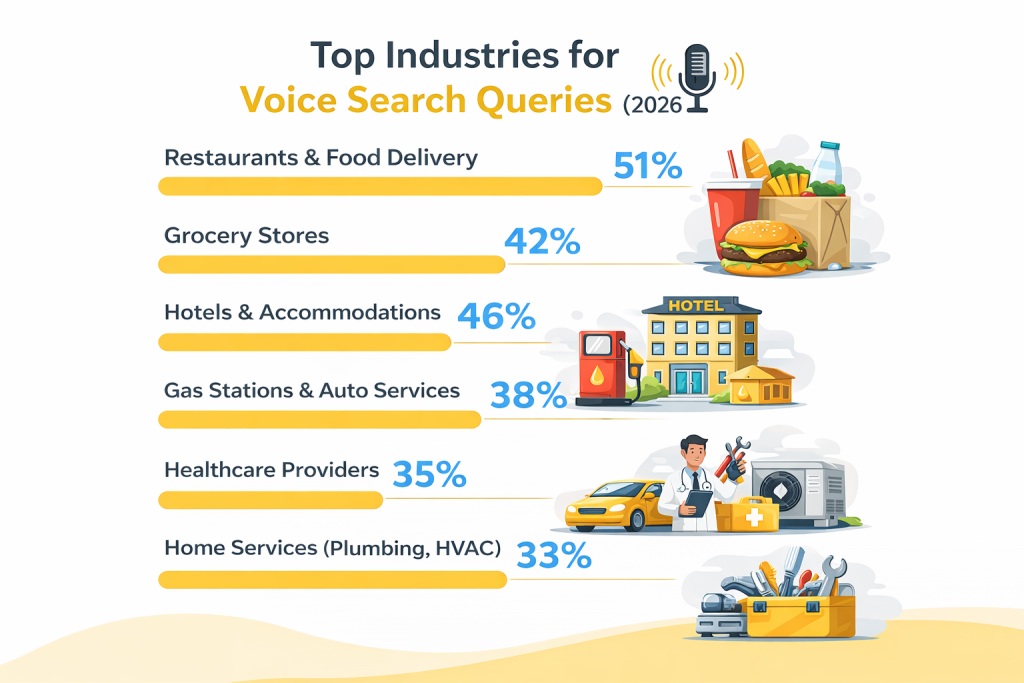
Voice search adoption varies significantly by industry. Understanding where your business fits helps prioritize optimization efforts:
Top Industries for Voice Search Queries (2026)
Common Voice Search Optimization Mistakes
Even with a solid strategy, many businesses make critical errors that undermine their voice search performance. Avoid these pitfalls:
- Writing for Search Engines, Not Humans: Voice assistants prioritize natural language. If your content sounds robotic or keyword-stuffed, it won’t be selected for voice answers.
- Ignoring Long-Tail Question Keywords: Short keywords don’t match voice search patterns. Focus on complete questions people actually ask.
- Neglecting Mobile Optimization: With 27% of voice searches on mobile, slow-loading or poorly formatted mobile sites kill conversions even if you rank well.
- Inconsistent NAP Data Across Platforms: Different addresses or phone numbers on Google, Yelp, and Bing confuse voice assistants and hurt rankings.
- No FAQ Schema Implementation: Without proper structured data, search engines struggle to understand your Q&A content format.
- Overly Complex Answers: Voice users want quick answers. If your content requires multiple paragraphs to answer a simple question, it won’t be selected.
- Ignoring Local Schema Markup: LocalBusiness schema is essential for helping voice assistants understand your service areas and location.
- Not Optimizing for Multiple Voice Ecosystems: Only optimizing for Google means missing Siri and Alexa users who search differently.
Ready to Transform Your Local Voice Search Visibility?
These 11 changes delivered a 67% increase in ‘near me’ traffic, but results vary by industry, competition, and implementation quality. The key is starting with the highest-impact changes first and iterating based on your specific analytics.
People Also Ask: Voice Search Optimization Questions
How do I optimize my website for voice search?
Optimize the voice search: reorganize contents based on question-based and long tail keywords, which are patterned to natural speech.
Build detailed FAQ pages with schema markup, make answers to featured snippet answers short (less than 29 word), make mobile page load times less than 3 seconds, add LocalBusiness schema with full NAP data, and talk to a customer (write conversational language). Concentrate on getting featured snippets, as 40.7 percent of voice responses originate at position zero.
The main distinction between traditional SEO and the new one is that of what people talk about and what they type.
What percentage of searches are voice searches?
Voice search is also used by about 20.5 percent of the global population, with 27 percent using it on mobile gadgets in particular. In the US, 58.6% of the people living in the country have used voice search at some point, and 32% voice search on a daily basis and ask questions that they would normally type in any search engine.
The adoption rate is still increasing as there are more than 8.4 billion voice assistant devices around the world as of 2026, which is more than the population of the world. Local business visibility is necessary because among smart speaker users, 76% list local voice searches per week and 46% local business searches per day.
Why is voice search important for local businesses?
Voice search is essential to the local business as 76 percent of all voice searches are locally oriented and therefore, three times more likely to be a location search than a text search.
Since 28% of the users call the business directly and 88% visit or call within 24 hours after the voice search, 18% of them purchase the same day. This formulates instant conversion opportunities.
Also, a majority of consumers (58 percent) utilize voice search with the express purpose of locating a local business, and 62 percent of car owners utilize voice assistants to locate a local business when driving.
As voice search is reported to be easier than typing by 90 percent of those who use it, local businesses that do not optimize face invisibility to the fast-growing search technique.
What is the difference between voice search and regular search?
Google Assistant uses Google Maps and Google Business Profiles in the first place when responding to voice queries due to the availability of local business information on the search engine. It ranks businesses in terms of distance, usefulness to the search query, and notoriety (number of reviews, ratings, and profile completeness).
The assistant is also drawing answers when the websites are ranked at the top three organic positions, and include snippets, they give 80% of the answer of voice search.
Businesses have to maximize their Google Business profiles using the correct NAP information, reply to reviews, post regularly, add LocalBusiness schema to their websites, and write specifically to respond to local queries that are question-based.
Uniformity in all directories online is of great importance, as any inconsistency may disorient the algorithm.
How does Google Assistant find local businesses for voice search?
Data markup Faq schema faq schema is structured data markup used to assist search engines with what constitutes the question and answer structure of faq content, allowing voice assistants to extract and provide accurate answers more easily.
It is important to voice search because voice searches are question-oriented, and the FAQ schema indicates to Google which content answers which question.
The use of the FAQ schema enhances your chances of making it to featured snippets and voice search results. Each question and answer is enclosed within a markup that specifically identifies the question and answer pair, enabling voice assistants to retrieve the precise response without having to process the unstructured text.
Companies that have an appropriate FAQ schema are much more visible in voice search than concepts with the same content that do not have one.
What is FAQ schema and why does it matter for voice search?
FAQ schema is structured data markup that helps search engines understand the question-and-answer format of FAQ content, making it easier for voice assistants to extract and deliver precise answers.
It matters for voice search because voice queries are overwhelmingly question-based, and FAQ schema signals to Google exactly which content answers which questions. Implementing FAQ schema increases the likelihood of your content being selected for featured snippets and voice search results.
The markup wraps each question and answer pair in code that explicitly labels them, allowing voice assistants to pull the exact answer needed without parsing unstructured content. Businesses with proper FAQ schema implementation see significantly higher voice search visibility compared to competitors with identical content but no schema.
Should I optimize for Siri and Alexa separately from Google?
Admittedly, the voice assistants are based on various data sources that need to be optimized independently. Google Assistant is based on Google Business Profiles and Google Maps, Siri on Apple Maps and Yelp reviews, and Alexa on Microsoft Bing and Yelp.
It implies that full voice search optimization will involve the process of claiming and optimizing your business on Google, Bing Places, and Yelp, making sure that NAP is consistent on all three. Although a lot of the strategy (conversation content, keywords in the questions, schema markup, etc.) will be similar, platform-specific optimization will make sure that you reach users no matter what voice assistant they operate.
Google Assistant has 88.8 million users, and Siri has 86.5 million users (both in the US alone), so getting your app optimized to work with several different ecosystems would get you a big reach.
The Future of Voice Search for Local Businesses
Voice search continues evolving rapidly, with several trends shaping the future of local search optimization:
Emerging Voice Search Trends
- Generative AI Integration: With Google phasing out Google Assistant in favor of Gemini and the rise of ChatGPT voice features, generative AI is transforming how voice assistants deliver answers. Businesses must optimize for conversational AI that generates responses rather than simply extracting them from existing content.
- Multi-Turn Conversations: Voice search is shifting from single queries to multi-turn conversations where users ask follow-up questions. Content must anticipate and address related questions comprehensively.
- Visual Voice Search Results: Smart displays and mobile voice assistants increasingly show visual results alongside spoken answers, creating opportunities for rich visual content optimization.
- Hyper-Personalization: Voice assistants leverage user history, location, and preferences to deliver increasingly personalized results, rewarding businesses that provide specific, detailed information.
- Voice Commerce Growth: The voice commerce market is projected to exceed $80 billion globally, with 35% of US adults interested in voice shopping, creating new monetization opportunities for local businesses.
Future Projection: By 2027, 162.7 million Americans will use voice assistants regularly, with voice commerce potentially reaching $80 billion globally. Businesses investing in voice optimization now will dominate local search in the next decade.
Implementation Roadmap: Getting Started
Implementing all 11 changes simultaneously can overwhelm small teams. Here’s our recommended phased approach based on impact and difficulty:
Phase 1: Foundation (Weeks 1-2)
- Audit current content for conversational language gaps
- Optimize Google Business Profile with Q&A and natural language descriptions
- Ensure NAP consistency across Google, Bing, and Yelp
- Identify top 10 question-based keywords in your industry
Phase 2: Content Restructuring (Weeks 3-6)
- Create comprehensive FAQ pages for each service/location
- Rewrite headers and titles as natural questions
- Reduce key answer lengths to 29 words or less
- Add conversational, natural language throughout content
Phase 3: Technical Optimization (Weeks 7-10)
- Implement FAQ schema markup on FAQ pages
- Add LocalBusiness schema to all pages
- Improve mobile page speed to under 3 seconds
- Create hyper-local neighborhood pages
Phase 4: Advanced Tactics (Weeks 11-16)
- Target featured snippets with formatted content
- Create How-To content with HowTo schema
- Optimize for multiple voice ecosystems (Siri, Alexa, Google)
- Implement speakable schema on key content
Phase 5: Measurement & Refinement (Ongoing)
- Track “near me” traffic weekly
- Monitor featured snippet captures
- Analyze phone call and conversion trends
- Continuously optimize based on performance data
Conclusion: The Voice Search Imperative
Voice search optimization isn’t a futuristic concern—it’s a present-day necessity for local businesses. With 76% of voice searches having local intent and 88% of users taking action within 24 hours, the businesses that optimize now will capture disproportionate market share.
Our 67% increase in “near me” traffic didn’t happen overnight. It required systematic implementation of conversational content, strategic schema markup, comprehensive FAQ optimization, and relentless focus on natural language. But the ROI was undeniable: more phone calls, more store visits, and more customers finding us at the exact moment they needed our services.
The voice search revolution has arrived. The only question is: will your business be heard?
Additional Resources
Voice Search Research & Data
- Statista Voice Assistant Statistics: Global adoption and usage data (statista.com)
- Think With Google: Voice search trends and consumer insights (thinkwithgoogle.com)
- Voicebot.ai: Industry news and research on voice technology (voicebot.ai)